01 / Govern
Govern
Decompose regulations, establish authoritative policies, scope statutory frameworks, and enforce organizational accountability across all three lines.

Connect requirements, controls, evidence, risk, audit, policies and resilience in one governed system built for continuous oversight and accountable decision-making.
Design intent, not a conformance or certification claim.
Decompose regulations, establish authoritative policies, scope statutory frameworks, and enforce organizational accountability across all three lines.
Evaluate design adequacy and operating effectiveness with deterministic evidence freshness gates, structured RCSA waves, and independent challenge.
Track deficiencies from discovery to verified remediation, monitor early-warning KRI thresholds, and manage residual risk dynamically.
The regulation lives in PDFs. The obligations live in spreadsheets. The controls live somewhere else again, and the operational link between them lacks systemic record. When a supervisor requests proof “show me how you know this control works”, the answer takes weeks to assemble.
Manual decomposition of complex statutory circulars leaves obligations unmapped, causing compliance gaps during regulatory examinations.
A control is marked “effective” because it always has been. No rationale, no independent challenge, no evidence anyone can retrieve later.
Findings sit in one system, remediation in another, risk in a third. Nobody can trace a weakness from the control that failed to the exposure it created.
Every stage produces structured outputs required by subsequent stages; no downstream evaluation can claim more than the stage before it actually established.
Upload circulars, standards, or frameworks. Documents are indexed and preserved with full source provenance.
AI assists with decomposing text into referenced obligations. Every suggestion is advisory until a human reviewer accepts it.
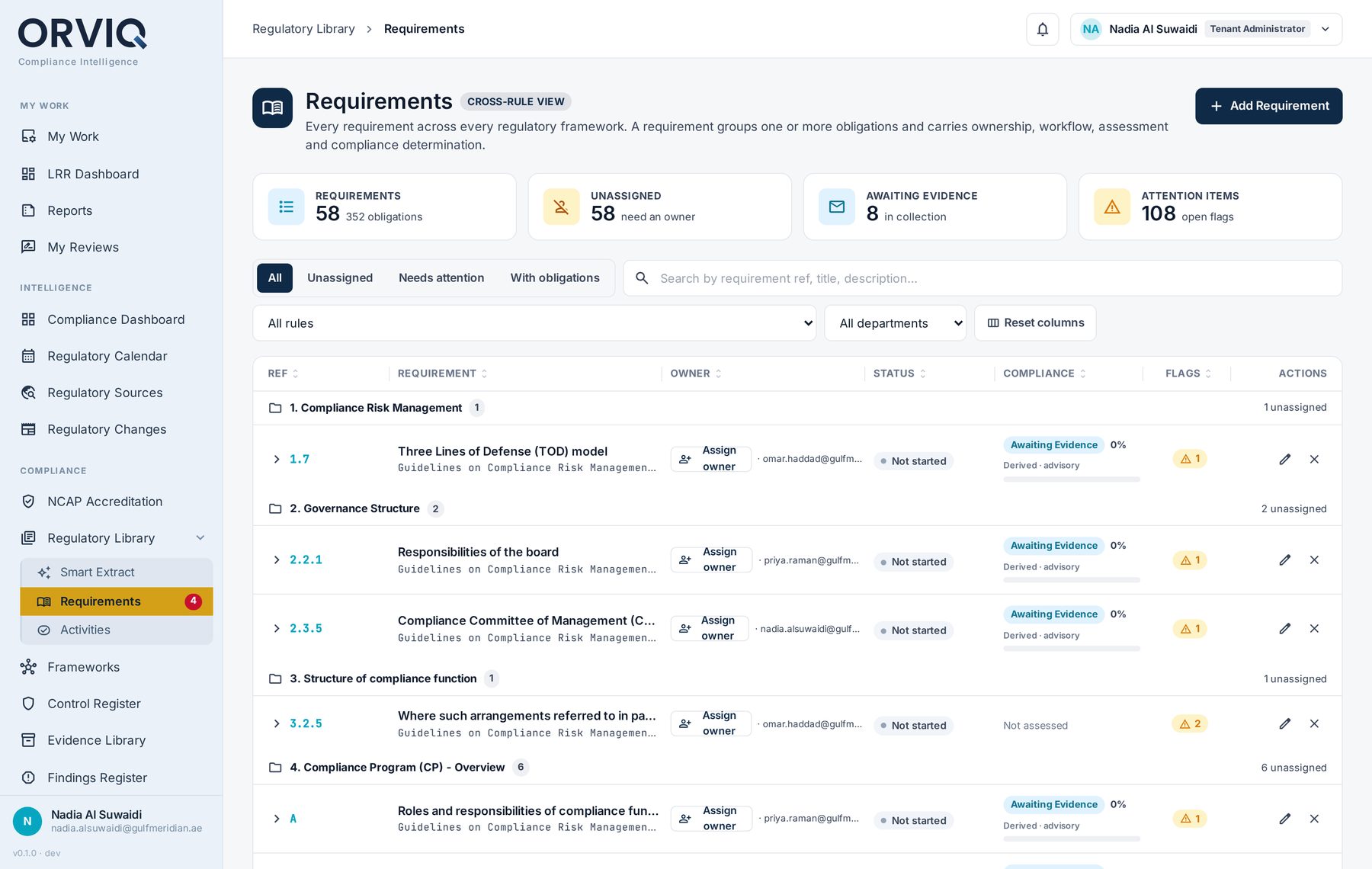
Obligations group into requirements carrying clear ownership, workflow state, and compliance determinations.
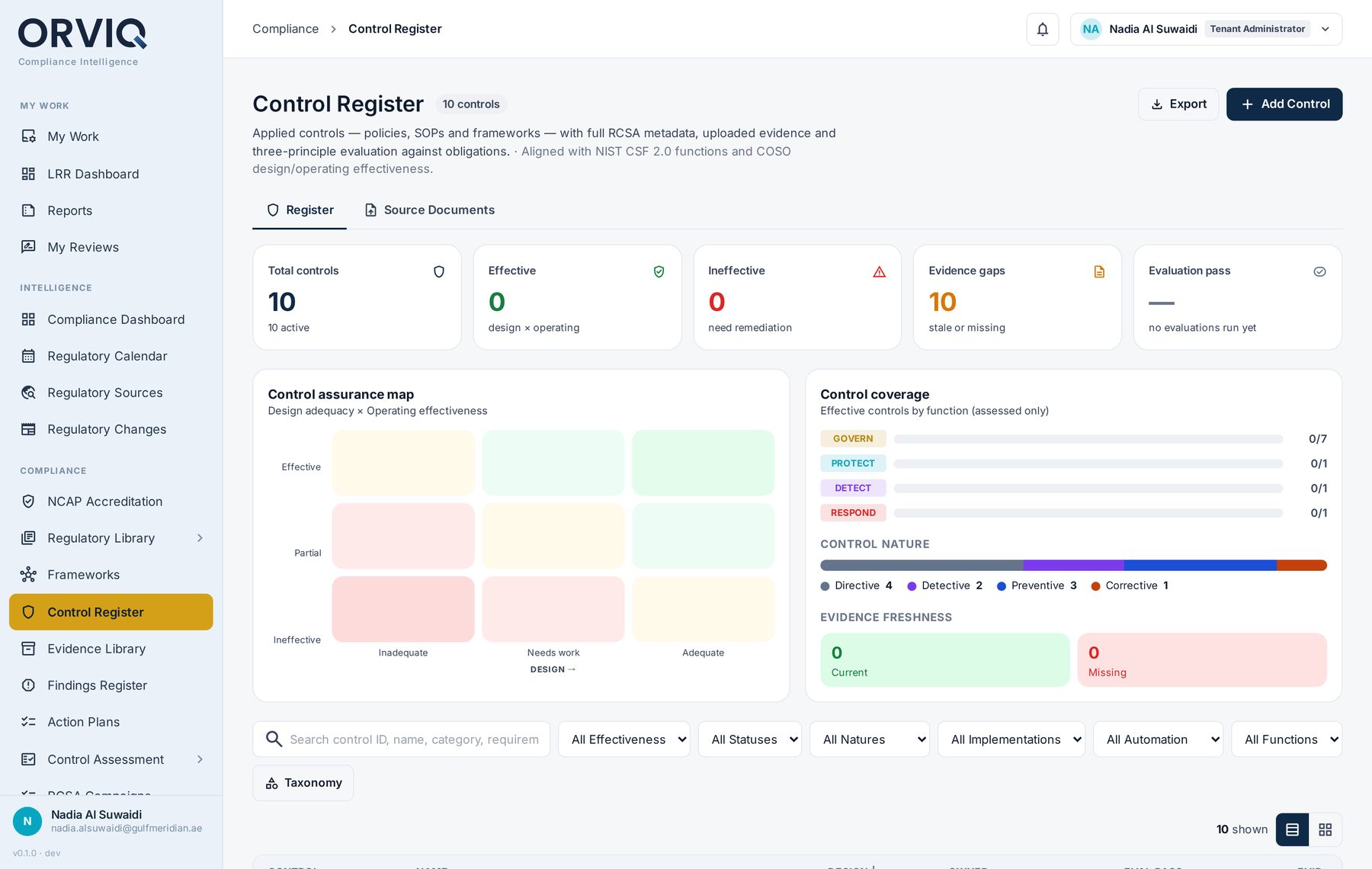
Requirements map to the Control Register in a common control language, so one control can serve many obligations.
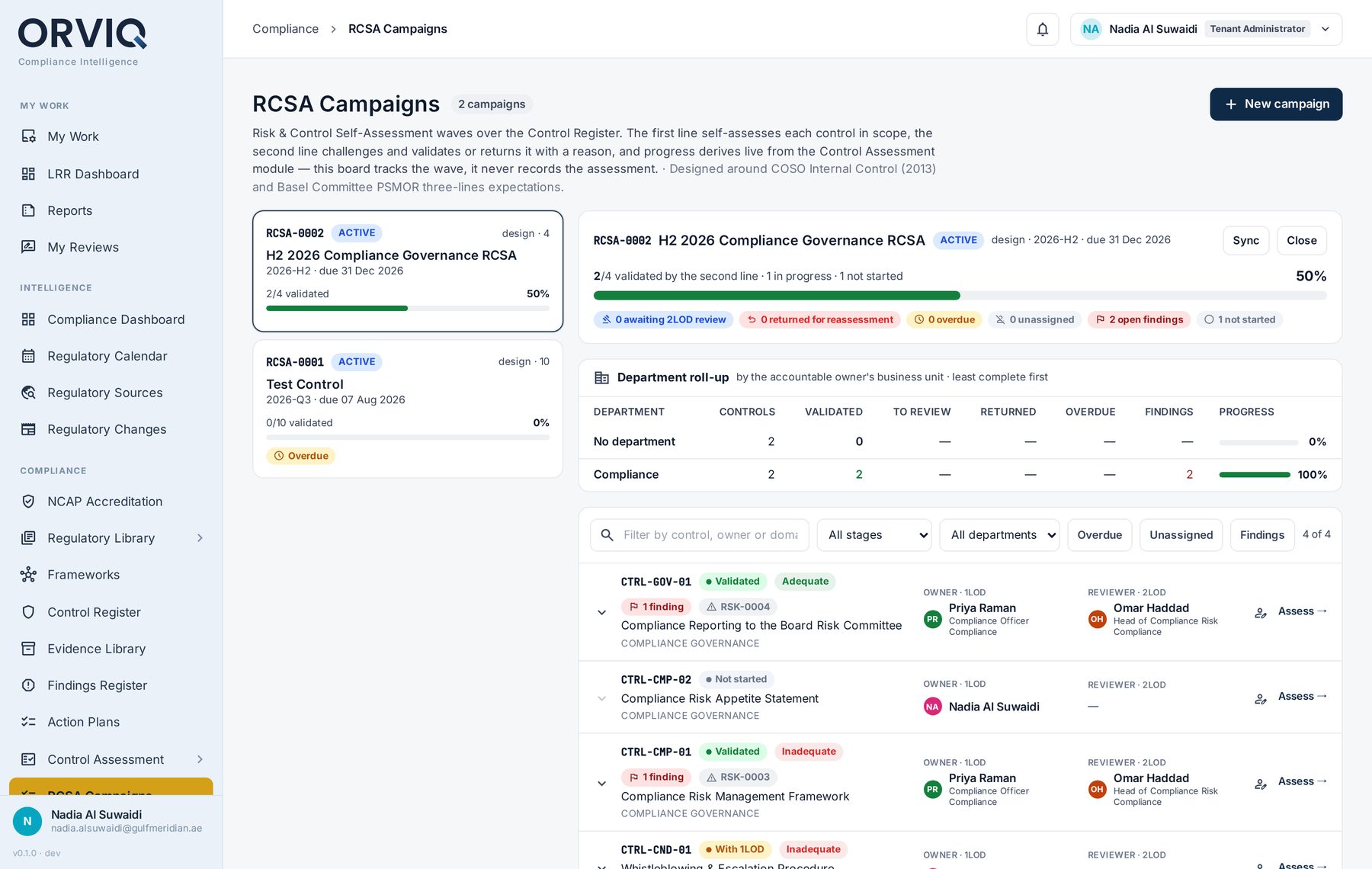
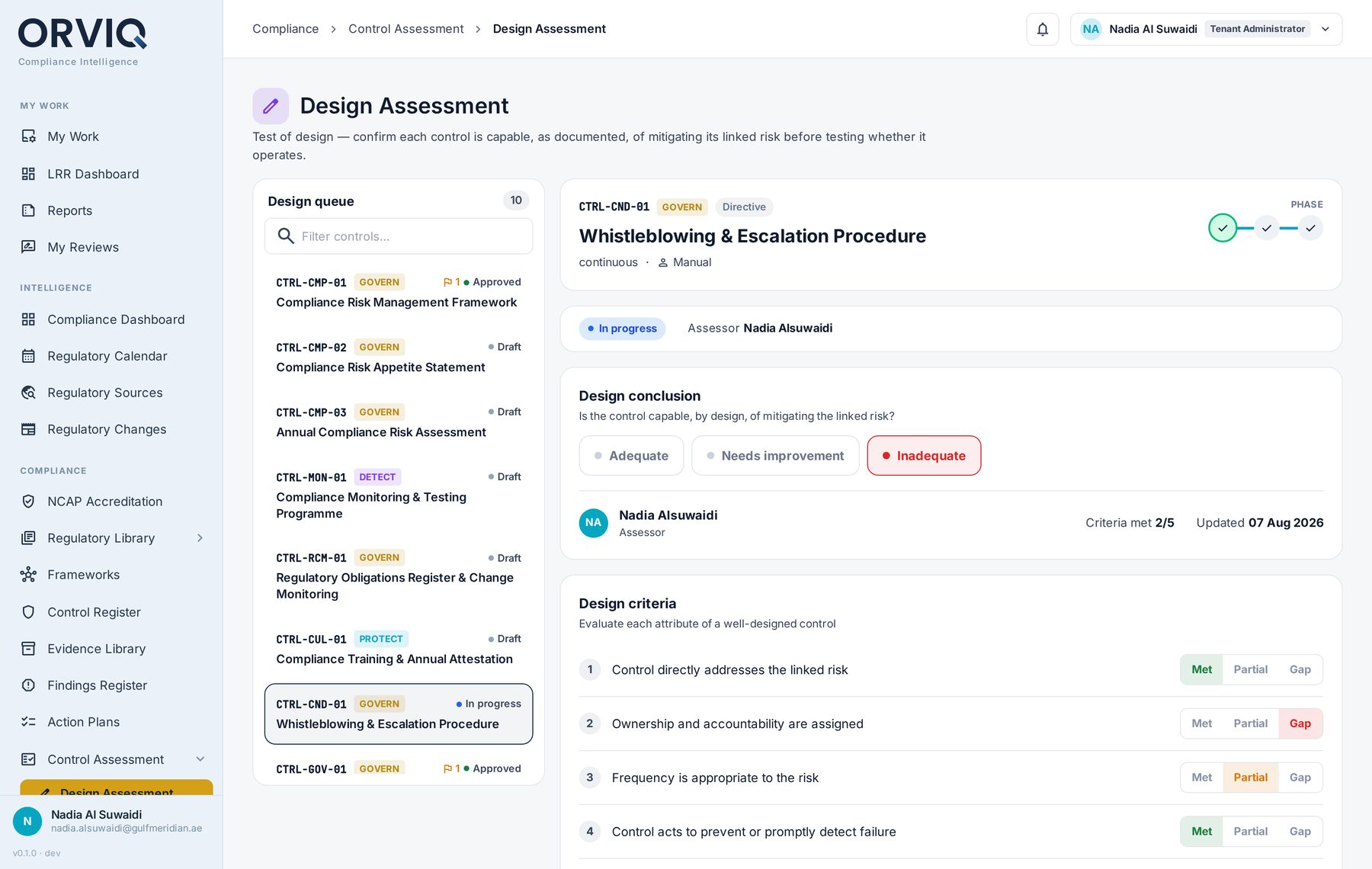
Design, operating and testing assessments: first line concludes, second line validates or returns with a reason on record.
Evidence is attached with a freshness lifecycle. A failing conclusion must raise a deficiency with a named owner.
Findings carry target dates and action plans, escalating into the Enterprise Risk Register when exposure warrants.
Live dashboards, departmental roll-ups, and a regulatory-change watch that alerts you when source obligations move.
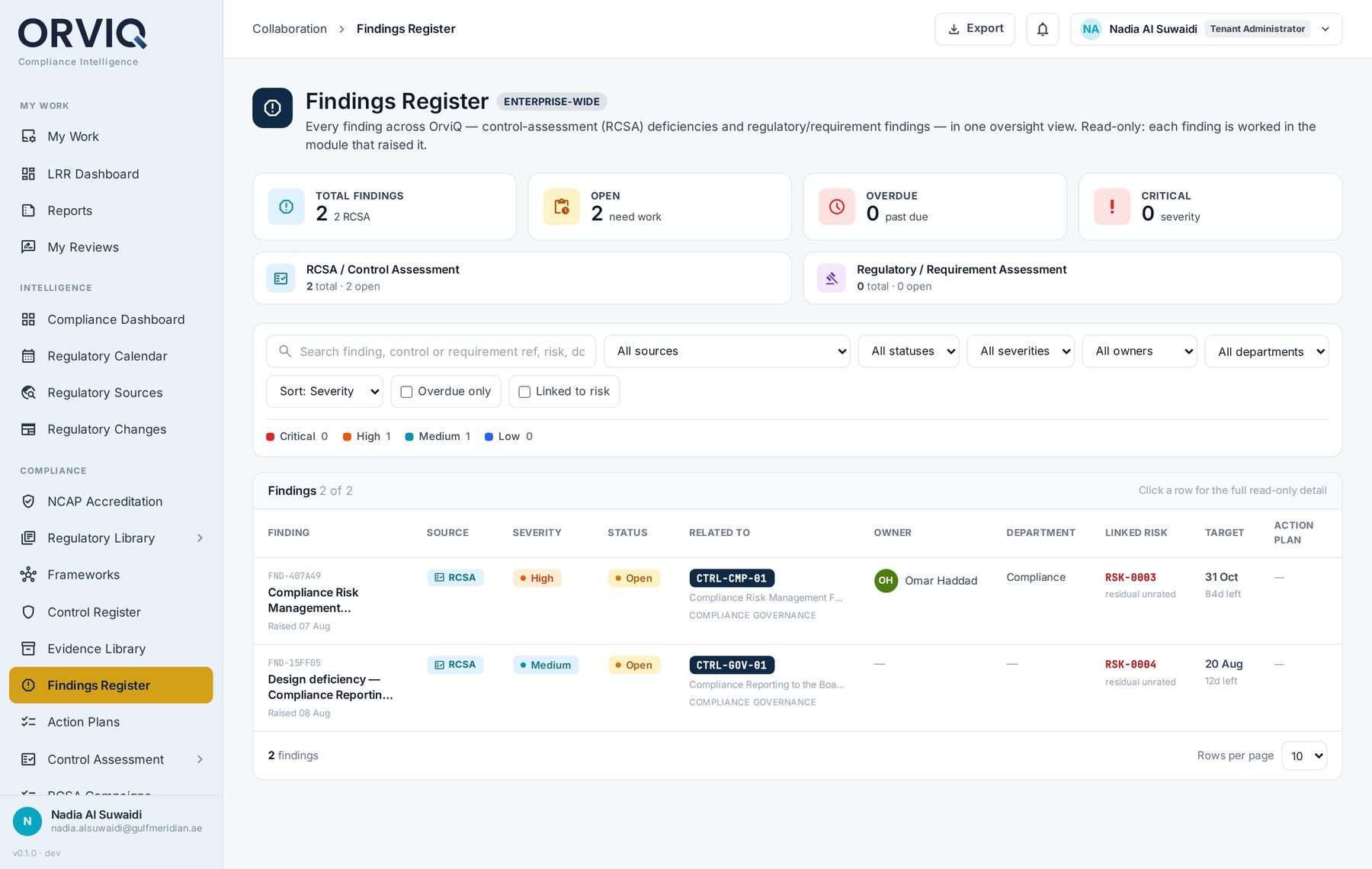
Screens from the live product. Explore any of them yourself in the demo.
Licensed per tenant, allowing institutions to deploy required modules on a single shared data model.
Ingest circulars, decompose obligations with advisory AI assistance, and track regulatory changes.
Dual design and operating effectiveness assessment, RCSA campaign waves, and 2LOD validation.
Risk register mapped to control health, KRI threshold monitoring, appetite bands, and residual risk.
Centralized deficiency register, corrective action plans (CAPA), SLA tracking, and risk promotion.
Versioned policy library, obligation gap analysis, expiry monitoring, and attestation campaigns.
Manage the audit lifecycle from engagement scope and testing workpapers to closed remediation.
Track supervisory examinations from notice to closure, managing observations and evidence packages.
Business impact analysis, service dependency mapping, scenario testing, and recovery objectives.
Vendor risk tiering, contract reviews, recurring assessments, and continuous supplier assurance.
This is the principle the product is engineered around. A number on a dashboard has to be derived from evaluated evidence and independent challenge, or it does not appear.
Work that has been started, or submitted and not yet reviewed, counts as zero. Only independently accepted work moves a completion figure.
A control owner cannot approve their own assessment. Refusals are applied when the action is attempted, not by hiding a button.
You cannot submit “this control is inadequate” without raising the deficiency, giving it a named owner, remediation plan, and date.
Extraction and assessment suggestions are recorded as recommendations. They never advance a workflow or determine compliance on their own.
Actor identity, challenge determinations, recorded rationale, and timestamps are recorded in an append-only audit trail.
Engineered for institutions requiring rigorous tenant isolation, immutable auditability, and clear governance boundaries. Deployment architecture, data-residency and private-infrastructure requirements can be assessed as part of enterprise solution design.
Every query is tenant-scoped at the data layer, not by convention in application code.
Granular permissions per role, enforced centrally on every request and verified against licensed modules.
Actor, action, before/after, and request context recorded on every governed change.
Integration credentials held in an encrypted vault and never returned by the API.
Configure dedicated AI provider boundaries so that sensitive regulatory and compliance text remains strictly governed.
Malware scanning on upload, rate limiting, CSRF protection, and automated health checks.
Explore our preloaded live environment to see how obligations, controls, evidence, and challenge connect into an auditable assurance chain, or request a technical walkthrough with our team.
Deployment architecture, data-residency and private-infrastructure requirements can be assessed as part of enterprise solution design.